Education
The Foundation of the Montessori Philosophy: The Prepared Environment and Developmental Materials
Emine Çengelci
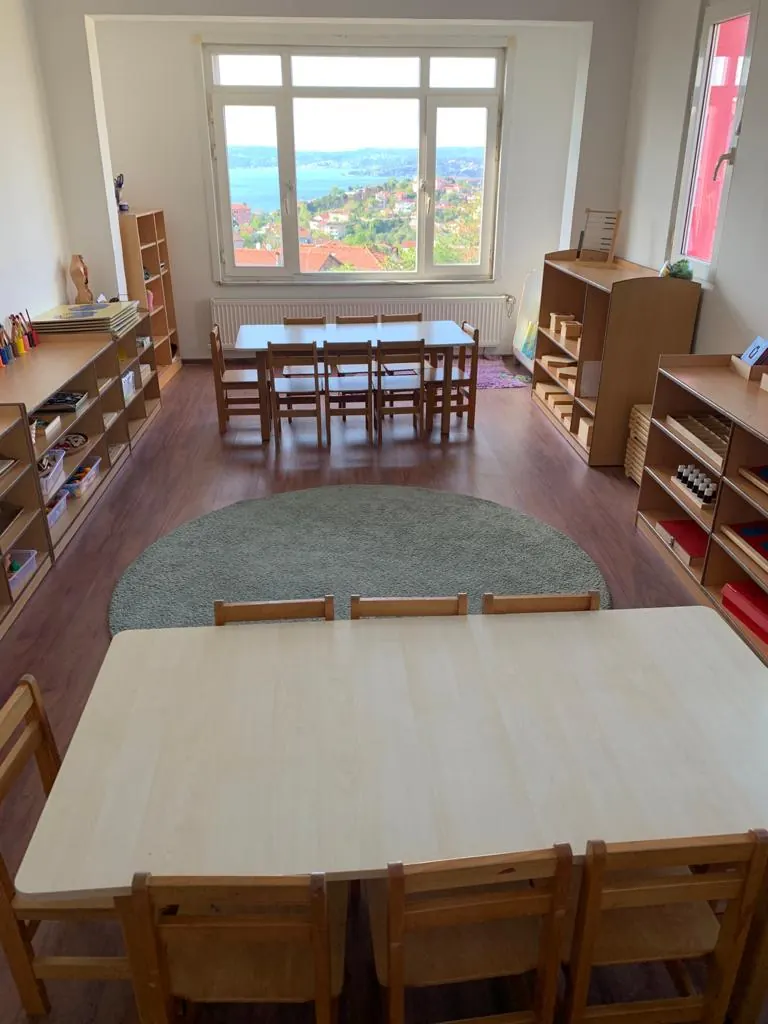
The Montessori system offers a specially prepared classroom in which children can develop their skills. Classrooms should contain objects in proportion to children's bodies; they should be bright and well lit, with low windows decorated with flowers, miniature furniture modelled on modern pieces, small tables and small chairs, and cupboards that children can easily open and close, filled with a variety of materials they can use as they wish. Learning materials should be arranged according to their purpose on low shelves that children can reach, from left to right and from easy to difficult.
The materials in the classroom should be clean, shiny and attractive to children, presented in perfect order, and placed so that children can take them from the shelves without help. There should be only one of each material in the classroom. This way, when children want to use a material, they wait for their friends to finish and learn to respect other people's work.
The Ideal Montessori Classroom
- Classes are made up of mixed-age groups spanning three years.
- To soften the classroom and keep it healthy, there should be large or small plants, large windows that let in fresh air, and windows that look out onto a natural setting such as a forest or garden.
- Children should have spaces where they can go out into the garden whenever they wish, to observe nature and develop their skills of research, investigation and discovery.
Individual Learning in Montessori Education
What matters is not that children receive information, but that they are educated according to their own needs and individual characteristics. Working one-on-one with the teacher allows the child to take the teacher directly as a model. Individual learning is planned so that each child works with materials suited to their development. Every child does the work they choose.
Montessori Materials
Montessori materials are divided into five groups:
- Practical Life
- Sensorial Materials
- Mathematics Materials
- Language Materials
- Cosmic Education Materials
1. Practical Life
The exercises in this area cover all the activities a child may encounter in daily life. They are not limited to self-care; they also include all the child's relationships with the living and non-living things in their immediate surroundings.
Practical Life Activities:
- Carrying a Table
- Carrying a Rug
- Opening and Closing a Door
- Folding a Napkin
- Braiding
- Spooning 1 (from one bowl to another)
- Spooning 2 (from a large bowl to small bowls)
- Pouring 1 (pouring grains)
- Pouring 2 (pouring liquids)
- Pouring 3 (pouring with a funnel)
- The Silence Game
- Dressing Frames
- Hand Washing
- Polishing Shoes
- Blowing One's Nose
- Sweeping a Table
- Dusting
- Washing a Table
- Polishing Metal
- Flower Arranging
2. Sensorial Materials
The education of the senses and sensorial materials form the foundation of Montessori education. Work with these materials helps and guides the child's mental activity. At the same time, it builds the child's mental structure and supports their inner order while contributing to their intellectual development. Each sensorial material isolates a single sense, so that a stimulus aimed at one sense is separated from the others and its effect is strengthened.
Sensorial Materials:
- Knobbed Cylinders
- The Pink Tower
- The Brown Stair
- The Red Rods
- Colour Tablets
- The Geometric Cabinet
- Touch Tablets: Recognition
- Touch Tablets: Matching
- Touch Tablets: Grading
- Fabric Swatches of Different Textures
- Sound Boxes
- Music Activities
- Baric (Weight) Tablets
- Thermic Bottles
- Thermic Tablets
- Smelling Bottles
- Tasting Bottles
- Geometric Solids and Base Cards
- Sorting Objects in a Container
- The Mystery Bag with Geometric Solids
- The Surprise Bag
3. Mathematics Materials
The most important feature of the mathematical mind is that it leads the child to mental estimation, the highest point of creative thinking. Nature's creativity also rests on mathematical foundations. In the Montessori system, the key feature of the mathematics materials is that they make abstract concepts concrete. Concrete things contain abstract concepts and develop abstract thinking.
Mathematics Materials:
- Red and Blue Number Rods
- Sandpaper Numerals
- Number Rods and Number Cards
- The Spindle Box
- Cards and Counters
- Introduction to the Decimal System
- Golden Bead Material
- The Stamp Game
- Introduction to the Number Cards
- Introduction to the Decimal System 2
- Group Operations with the Four Operations
- The Dot Game
- Problem Solving
- The Coloured Bead Stair
- Seguin Boards 1
- Seguin Boards 2
- Counting Forward with the Hundred and Thousand Chains
- The Snake Game for Addition
- The Addition Strip Board
- The Snake Game for Subtraction
- The Subtraction Strip Board
- Preparation for Multiplication with Coloured Bead Bars
- The Multiplication Bead Board
- Multiplication with Control Charts
- The Division Board, Control and Working Charts
- The Small and Large Bead Frames
4. Language Materials
Language is our most important means of communication. Language and thought are closely connected, and language is therefore a tool of the mind. Maria Montessori approached language education holistically. Language is a construction of meaningful symbols and describes events in our inner and outer worlds. Maria Montessori held that in language education writing comes before reading, and she demonstrated this through the materials she designed.
Language Materials:
- Opportunities and Exercises to Develop the Child's Language and Vocabulary
- Supporting Vocabulary Development
- Metal Insets
- Sound Games with Miniature Objects (Object Boxes)
- Sandpaper Letters
- The Moveable Alphabet 1
- The Moveable Alphabet 2
- The Moveable Alphabet 3 (for introducing capital letters)
- Reading Boxes with Miniature Objects
- Reading Labels for Objects in the Environment
- Picture and Word Cards (Classification)
- Command Cards
- Picture Reading Books
- Definition Work
5. Cosmic Education Materials
Maria Montessori emphasised that presenting nature and culture is essential, especially in early childhood education, and that the harmonious order of the universe is what gives this meaning. She stressed that, in principle, the truth lies in reflecting on the details in order to see the whole. Montessori considered cosmic education essential so that children can gather experiences and begin to relate to the world. Children gain many experiences while still at home: rain, wind, rocks, soil and eating habits, for example.
Cosmic Education Materials:
- Land and Water Forms
- Shapes of Land and Water
- The Sandpaper Globe
- The Coloured Globe
- Puzzle Map of the World
- Puzzle Maps of the Continents
Thank you for reading.
Share this article with people you care about.